

Urban Perception
How people perceive safety and disorder in cities from street imagery
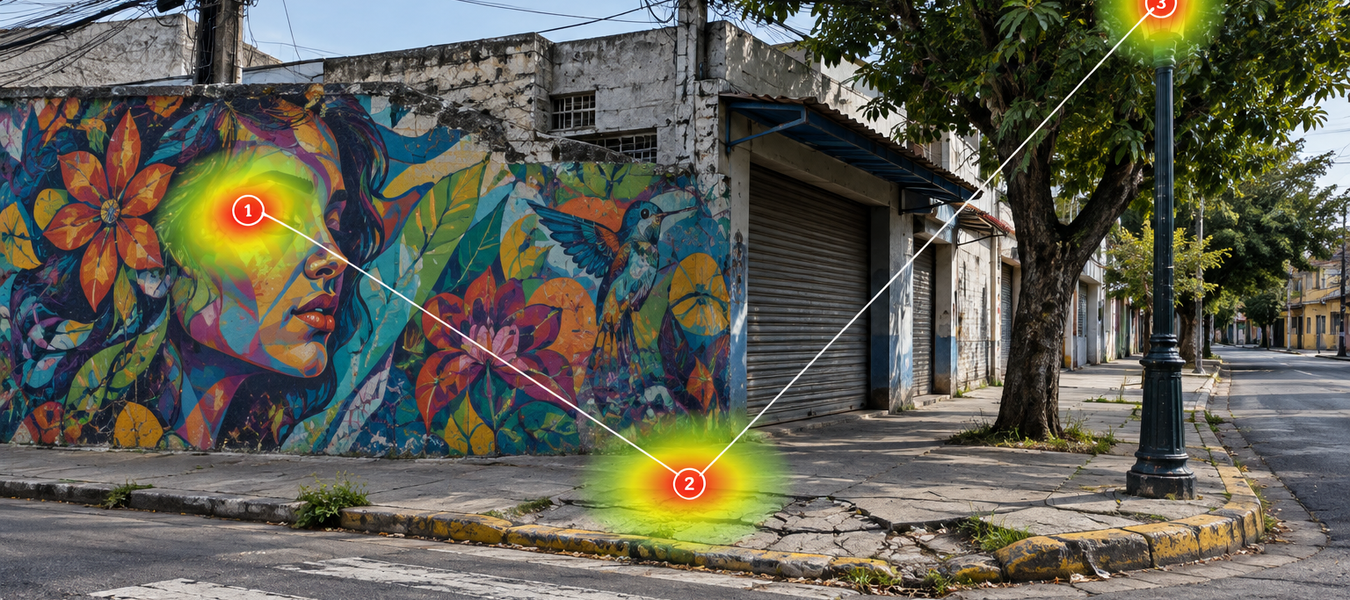
Urban Perception studies how people perceive safety, disorder, and quality in urban environments, and which visual elements of the streetscape drive those judgments. Starting from street-view imagery annotated with perceptual scores, we train vision models that quantify perceived safety and explain their decisions through saliency and counterfactuals, and we compare them against human raters and vision-language models. We enrich the image-level view with annotations of physical disorder (graffiti, damaged infrastructure, overhead cables) and with head-mounted eye-tracking studies that reveal where observers look while rating a street. Unlike Crime Analytics, which works with recorded events, this project works with how the city looks and feels, giving planners interpretable evidence about which changes to the built environment change how a place is perceived.
Researchers
-
 Jorge Poco FGV EMAp
-
 Felipe Moreno-Vera FGV EMAp
-
 Mauro Diaz FGV EMAp
-
 Andres De La Puente FGV EMAp
-
 Luis Sante FGV EMAp
-
 Bruno Brandoli Dalhousie University
-
 Bahram Lavi UNICAMP
In collaboration with
-
 Claudio T. Silva NYU
-

Publications

WI-IAT · Conference
Quantifying Urban Safety Perception on Street View Images

VISAPP · Conference
17K-Graffiti: Spatial and Crime Data Assessments in São Paulo City
Bahram Lavi, Eric Tokuda, Felipe A. Moreno-Vera, Luis Gustavo Nonato, Claudio Silva, Jorge Poco


