
Assessing Urban Environments with Vision-Language Models: A Comparative Analysis of AI-Generated Ratings and Human Volunteer Evaluations
IEEE International Joint Conference on Neural Networks · July 2025


Abstract
This research investigates the application of vision-language models to automatically assess and rate street view images based on the Place Pulse 2.0 dataset, with a focus on comparing AI-generated ratings with human evaluations. The study introduces a context-sensitive rating system that assigns a 0-10 scale to six key urban perception categories: safety, liveliness, wealth, beauty, boredom, and depression. By comparing these AI-generated ratings with those of human volunteers, the research explores how effectively vision-language models can replicate human judgment in assessing urban environments. The findings provide valuable insights into the potential of vision-language models to scale urban perception analysis, offering an objective methodology that complements and enhances human evaluation. This approach not only contributes to urban planning by enabling more efficient, data-driven decision-making but also enriches the Place Pulse 2.0 dataset by integrating machine-generated ratings, paving the way for future advancements in urban perception studies.
Part of
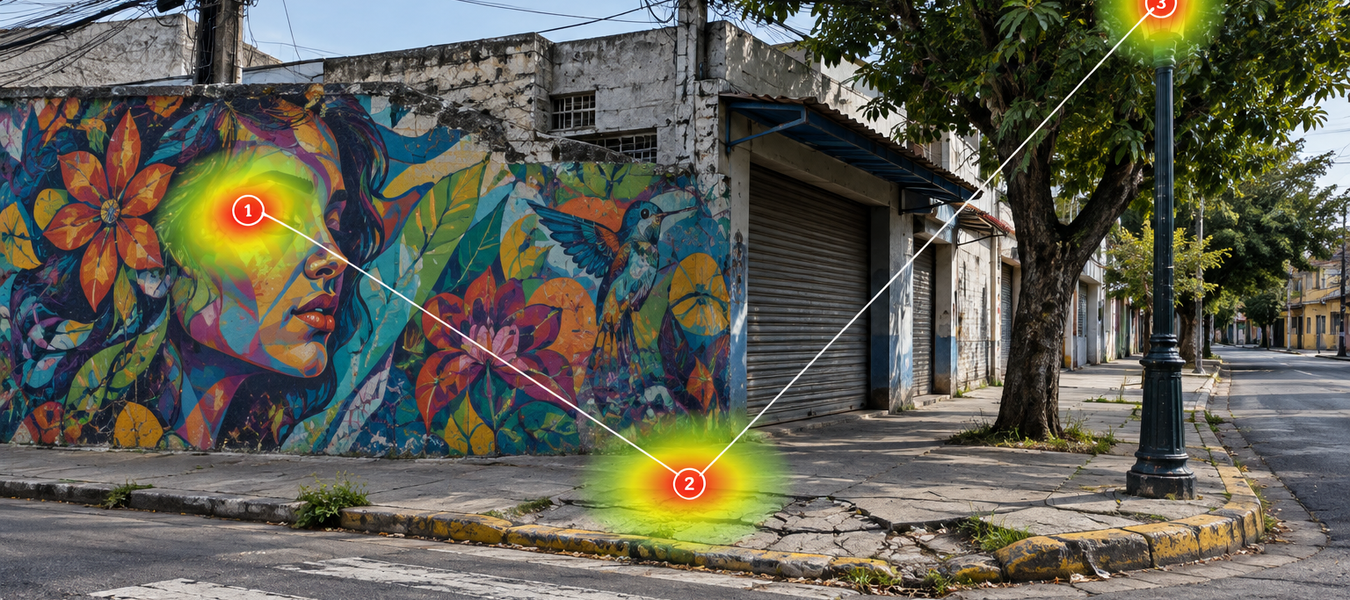 Urban Perception
▸ Cite this paper (BibTeX)
@article{2025-UrbanVLM,
  title={Assessing Urban Environments with Vision-Language Models: A Comparative Analysis of AI-Generated Ratings and Human Volunteer Evaluations},
  author={Felipe A. Moreno-Vera and Jorge Poco},
  journal={IEEE International Joint Conference on Neural Networks},
  year={2025},
  url={https://ieeexplore.ieee.org/},
  date={2025-07-05}
} Related papers
-

UrbanGazeVis: A Visualization System for Analyzing Eye-Tracking Data on Urban Safety Perception
-

UrbanPhysicalDisorder-4K: Understanding Urban Perception via Counterfactuals and Street View Signs of Physical Disorder
-

What Makes a Place Feel Safe? Analyzing Street View Images to Identify Relevant Visual Elements
-

17K-Graffiti: Spatial and Crime Data Assessments in São Paulo City
-

Quantifying Urban Safety Perception on Street View Images
-

Urban Perception: Can we Understand Why a Street is Safe?